...
Request a consultation

Permits, HOA Rules & Building Codes for Window and Door Replacement in Colorado

Before a window or door replacement project starts in Colorado, we should confirm a few things. Whether the local jurisdiction requires a permit, whether the home is subject to HOA or historic district review, and whether the scope changes the opening size, egress, or another code-sensitive condition. 

This order is important. It’s because a like-for-like replacement can move very differently from a new opening, a resized opening, or work on a historically designated property.

The cleanest path is simple and practical. We should treat permits, HOA approval, and code compliance as separate checkpoints, then line them up before products are ordered or installation begins.

Key takeaways

  • We should verify permit rules with the city or county that has jurisdiction.
  • HOA approval and building permits are not the same thing.
  • Like-for-like replacement can be treated differently from a new opening.
  • Historic districts and landmarked homes can trigger extra review.
  • Egress and safety rules matter when bedroom windows are involved.
  • The smoothest projects usually start with approvals before materials are ordered.

Why is there not one statewide checklist for every Colorado home?

Two different Colorado homes showing why window replacement checklists vary by property

Colorado does not use one universal checklist for every replacement project. Permit and inspection rules are handled locally. That means the review path can change by city, county, and property type, even when two projects sound similar on paper.

Local verification comes first. We should confirm which jurisdiction controls the property before we assume a permit path, inspection requirement, or approval timeline.

When do permits usually come into the picture?

Plans and measurements on a table inside a Colorado home with large replacement windows

Permits usually come into the picture when the work goes beyond a straightforward like-for-like replacement and starts changing the opening, the layout, or a safety-related condition. That is why the project scope matters so early.

Denver’s residential permit guidance states that permits are required for new window installations, egress windows, and changes to doorway openings, while routine replacement of existing components can be treated differently depending on scope. We should use that as a model for asking the right local questions.

If we are resizing an opening, adding a new window, changing an exterior door opening, or affecting bedroom egress conditions, we should expect a permit conversation early. That helps keep the schedule realistic and the product choices aligned with the actual scope of work.

How do building codes affect window and door replacement?

Modern Colorado home interior with large black-framed windows and door system for replacement planning

Building codes affect window and door replacement. It’s because the work is judged not only by appearance, but also by safety, structural fit, weather protection, and whether the finished opening meets the adopted local code for the scope being done. That becomes more important when the project involves egress windows, new openings, or major modifications.

Boulder’s residential building permit guide says applicants must identify which windows will meet emergency escape and rescue requirements and detail window wells at egress windows. It’s a practical reminder that code review can shape the design itself, not just the paperwork. 

Exterior doors can raise similar issues. If the project changes thresholds, landings, structural framing, or the dimensions of an opening, the work can move beyond straightforward replacement and into a more review-heavy category.

Do we need HOA approval for window replacement?

Window sample boards and replacement options reviewed for HOA approval in a Colorado home

HOA approval for window replacement depends on whether the home is in a common interest community and whether the association reviews visible exterior changes. That is a separate question from whether the city or county requires a permit.

This is where projects can slow down. A homeowner can confirm that a local permit is not required for a like-for-like replacement and still needs HOA review for visible exterior changes such as frame color, grille pattern, material, or profile, so permit approval and HOA approval should never be treated as interchangeable.

What if the home is in a historic district or is landmarked?

Traditional-style Colorado home with replacement windows suited to historic district guidelines

Historic homes need extra care. Properties in designated districts can face a different review path before products are ordered or demolition begins, because material choices, sightlines, trim details, and opening dimensions can all become part of the approval process.

It can affect both product choice and timing. A replacement that feels straightforward from a construction standpoint can still require design review if the home is historically designated, so we should identify that status before measurements are finalized and materials are ordered.

What steps should Colorado homeowners follow before starting replacement work?

Plans and measurements prepared before window replacement in a Colorado home

Colorado homeowners should follow the approval sequence before ordering products or scheduling installation. The cleanest process starts with jurisdiction, then moves through scope, review requirements, and final documentation.

  • Confirm which city or county has jurisdiction over the property
  • Confirm whether the project is like-for-like or changes the opening
  • Check whether the home is in an HOA
  • Check whether the home is in a historic district or has landmark status
  • Confirm whether egress or other safety rules apply
  • Verify permit and inspection requirements with the local authority
  • Finalize measurements, product selections, and written scope after approvals are clear

What usually triggers inspections?

Inspections usually follow permitted work. If the project creates a new opening, changes framing, affects egress, or falls into another reviewed scope, inspection is usually part of the same approval path.

We should not treat inspection as an afterthought. If the scope triggers a permit, inspection should be built into the project schedule from the start.

How do we keep the process from slowing down the project?

Window replacement plans and organized project documents inside a Colorado home

It’s important to protect the schedule. The best way to do it is to make decisions in the right order and document the scope clearly. We should identify the jurisdiction, confirm whether the work is like-for-like or changes the opening, review the HOA and historic constraints, and then move into final specification and scheduling.

Good documentation helps. Clear measurements, existing-condition photos, product details, and a written scope make permit questions and architectural review questions easier to answer, while comparing Colorado window quotes can help homeowners spot scope differences before the project moves into final scheduling.

FAQs

FAQ graphic about permits, HOA rules, and building codes for window replacement in Colorado

Do all replacement windows need a permit in Colorado?

No. Local jurisdictions decide that, and some treat like-for-like replacements differently from new openings or resized openings, which is why the city or county should always be checked before work begins.

If the HOA approves the project, are we done?

No, because HOA approval does not replace a building permit when a permit is required. They serve different purposes, and both can apply to the same project.

Do historic homes need extra review?

They can, especially when the property is in a historic district or has landmark status. In those cases, design review can affect dimensions, materials, trim details, and the overall approval timeline.

What is the biggest mistake homeowners make here?

The most common mistake is treating product selection as the first step. The cleaner path is to confirm permit, HOA, and code constraints first, then finalize the product and installation plan around those realities.

Checklist

Window replacement checklist graphic over project documents inside a modern Colorado home

  • Confirm which city or county has jurisdiction
  • Confirm whether the work changes the opening
  • Confirm whether the home is in an HOA
  • Confirm whether the home is historic or landmarked
  • Confirm whether egress rules apply
  • Confirm permit and inspection requirements
  • Confirm approvals before ordering products

Summary 

The cleanest window and door replacement projects in Colorado start with clarity. When we confirm local permit requirements, HOA or historic review, and code-sensitive scope before products are ordered, the project moves with fewer surprises and a more realistic timeline.

If you want help planning a replacement project around Colorado’s approval and installation realities, we can help you evaluate the right scope, sequence, and product fit for your home. Book a professional consultation to start with a clear proposal and a process built around Colorado conditions.
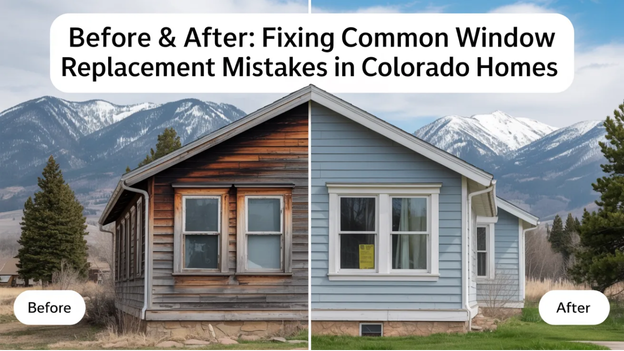
Before & After: Fixing Common Window Replacement Mistakes in Colorado Homes

The most common window replacement mistakes in Colorado homes are choosing the wrong replacement method (insert vs. full-frame), skipping proper flashing, and failing to air seal around the window—because those three mistakes lead to drafts, water intrusion, and disappointing performance.

The fix is usually not “a better window” but a better system: the right replacement approach plus modern flashing and sealing.

Key Takeaways

Key takeaways are that full-frame replacement enables the best water and air management, insert replacement is situational, and sealing details are where most projects win or lose.

  • Flashing must direct water out, not into the wall cavity.
  • Rough-opening air sealing prevents major leakage pathways.
  • Insert replacement reduces glass area and can hide problems if the frame is compromised.
  • Full-frame replacement is intrusive, but it’s the highest performance option.
  • Even high-efficiency windows need correct installation to perform as intended.

What are the most common window replacement mistakes?

The most common window replacement mistakes are:

  1. Picking insert replacement when the frame is damaged
  2. Missing or improperly lapped flashing
  3. Not sealing the rough opening air gap
  4. Using the wrong foam or overfilling gaps (causing frame deflection)
  5. Ignoring water intrusion signs (stains, soft sills, peeling finishes)

Building America guidance stresses that windows are a common location of water infiltration problems, and installation should follow modern flashing, water sealing, and air sealing practices aligned with ASTM E2112.

Before & After #1: “The insert-over-rot problem”

Before: A homeowner chooses an insert (“pocket”) replacement because it’s faster and less disruptive. The new unit fits inside the existing frame, but the existing sill and frame have hidden deterioration. Over time, the same leakage pathway continues, and comfort doesn’t improve as expected.

After: The homeowner switches to complete window and frame replacement. This approach removes the full frame back to the rough opening, allowing repairs, new flashing integration, and modern air sealing. Building America calls this the “highest performance” (but most intrusive) option and notes it enables installation using modern standards and techniques.

What changed: the project stopped “covering” the problem and started correcting the enclosure details that caused it.

Before & After #2: “The missing sill pan / wrong flashing lap”

Before: The window is installed, but flashing is incomplete or sequenced wrong. Water that gets behind siding can get directed into the wall instead of out. The interior looks fine—until it doesn’t.

After: The opening is reflashed with properly lapped sill (pan) flashing, side flashing, and head flashing, integrated with the drainage plane so water is directed out. Building America’s flashing guide emphasizes that windows and doors interrupt the wall drainage plane and must be fully flashed to prevent hidden damage.

What changed: water management became a system, not a bead of caulk.

Before & After #3: “The drafty finish (insulation without air sealing)”

Before: A window is installed and trimmed, but the gap between the window frame and rough opening is stuffed with fibrous insulation only. The homeowner still feels drafts and hears more outside noise than expected.

After: The gap is sealed correctly with backer rod, low-expansion foam, and/or caulk—without bending the frame. Building Science Education notes that rough openings can be major leakage points, and cites ORNL testing showing that sealing the gap can cut leakage dramatically compared to leaving it unsealed.

What changed: the gap became an air barrier, not just “filled space.”

How do you decide between full-frame vs. insert replacement?

You decide between full-frame vs. insert replacement by looking at the condition of the existing frame and your goals.

Insert replacement is a method of installing a new framed window within the original frame, and it has tradeoffs like reduced vision area and appearance impacts.

Complete (full-frame) replacement removes the entire window frame back to the rough framing, which allows new flashing, sealing, and repairs—but it’s typically more disruptive and costly.

A simple rule that holds up:

  • Choose insert only when the existing frame/sill is sound and square.
  • Choose full-frame when you see (or suspect) water damage, rot, or chronic leakage paths.

What should your installer be able to explain clearly?

Your installer should be able to explain the installation steps, not just the window brand.

Ask:

  • “How will you flash the sill, jambs, and head, and how does it tie into the drainage plane?”
  • “How will you air seal the rough opening—what material, where, and how do you avoid frame deflection?”
  • “If you find rot or damage after removal, what’s the repair plan?”
  • “Are you installing according to the manufacturer’s instructions?” (DOE notes improper installation can void warranties and reduce performance.)

Example / Template

Example / template scopes make quotes comparable and prevent “missing steps.”

Scope line item What “good” looks like Why it matters
Replacement method Insert only if the frame is sound; full-frame if damaged Wrong method = hidden problems remain
Flashing Sill pan + side + head, properly lapped Directs water out, prevents wall damage
Air sealing Backer rod/low-expansion foam/caulk as appropriate Reduces drafts and leakage pathways
Final checks The window operates smoothly; locks align Misalignment reduces sealing and security

FAQs

What is an “insert” (pocket) replacement window?

An insert (pocket) replacement window is installed within the original window frame after removing the operable sash and stops, which typically retains exterior trim like brick molding. It can improve performance, but it reduces the vision area and is not the best choice when the existing frame is compromised.

When is full-frame replacement the smarter choice?

Full-frame replacement is the smarter choice when there is rot, water intrusion, out-of-square openings, or when you want modern flashing and sealing integrated from the rough opening outward. Building America notes it is the highest performance option but more intrusive.

Should window replacement include flashing even if siding isn’t being replaced?

Yes—window replacement should still include proper water management details because windows are a common location of water infiltration. Properly integrated flashing helps direct water out and reduces the risk of hidden wall damage.

Why do new windows still feel drafty sometimes?

New windows can still feel drafty when the rough opening gap is not air sealed correctly or when foam/backer rod is installed in a way that deflects the frame. ENERGY STAR and Building Science guidance both emphasize sealing behind trim and using appropriate materials for gaps.

Checklist

A checklist prevents “pretty windows, bad performance.”

  • Confirm the right replacement method (insert vs. full-frame).
  • Require a flashing plan that ties into the drainage plane.
  • Require interior rough-opening air sealing details.
  • Confirm the installer follows manufacturer instructions.
  • Confirm smooth operation and lock alignment at walkthrough.

Summary

Most “bad window replacements” are really enclosure failures: wrong method, weak flashing, and missed air sealing. When those three issues are fixed, comfort and performance usually improve immediately and stay stable over time.

If you want your replacement to last in Colorado, treat the project like a system: the window, the water management, and the air sealing all have to work together. That’s how you avoid the painful cycle of “new windows, same problems.”

Want a window replacement scope that’s built for Colorado, not just a generic install? Contact us for a complimentary consultation and ask us to walk you through full-frame vs. insert options, flashing details, and air sealing so your upgrade actually performs. We serve Colorado Springs and the entire Front Range.